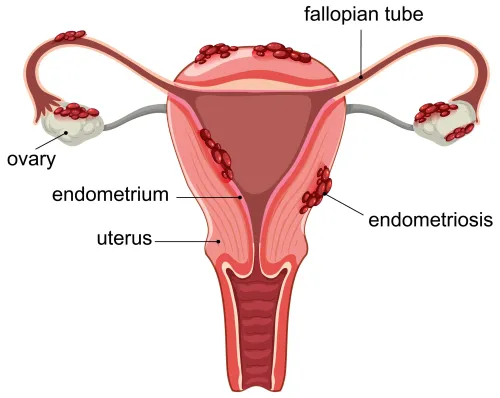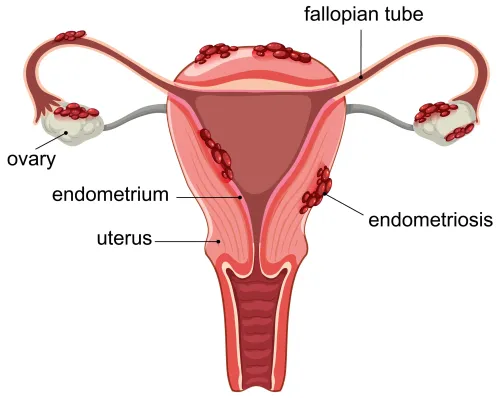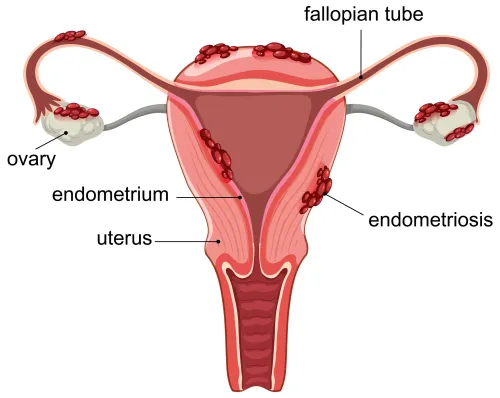

An ovarian endometrioma can cause pain, infertility and a complex-looking mass, but those findings do not establish ovarian cancer. You will learn which test results change the next step, when routine laparoscopic cyst surgery is unsuitable, and what to ask during a specialist consultation in Pune.
Key takeaways
- Ground-glass ultrasound findings support endometrioma but do not exclude cancer.
- Solid nodules, internal blood flow or suspicious imaging need specialist assessment.
- Choose surgery only after considering fertility and the cancer-staging plan.
- Ask who will perform staging if cancer is found during surgery.
How an endometrioma differs from a suspected ovarian cancer
An ovarian mass is more consistent with an endometrioma when ultrasound shows a uniform, low-level “ground-glass” pattern, smooth walls and no solid nodules or internal blood flow. Endometriomas often occur with painful periods, deep pelvic pain, infertility or known endometriosis. These clues support the diagnosis but do not exclude cancer.
| Finding | More consistent with endometrioma | Requires cancer evaluation |
|---|---|---|
| Ultrasound | Homogeneous cyst, smooth margins, stable appearance | Solid areas, papillary projections, thick irregular walls, blood flow, ascites or both ovaries involved |
| MRI | Typical blood-product signal that changes on different sequences | Enhancing solid tissue, restricted diffusion or invasive-looking disease |
| Symptoms | Cyclical pain, painful intercourse or infertility | Persistent bloating, early fullness, unexplained weight loss or increasing abdominal swelling |
| CA-125 | Normal or moderately raised | Markedly raised, especially with suspicious imaging; the result alone cannot diagnose cancer |
CA-125 can rise with endometriosis, menstruation, fibroids and pelvic infection. Normal results also do not rule out ovarian cancer. A rapidly enlarging, large, complex or fixed mass needs review by a gynecologic oncology team rather than routine cyst removal.
During an endometriosis expert Pune consultation or a laparoscopic surgeon ovarian cancer consultation, take the ultrasound or MRI images, reports, CA-125 results, surgical history, family cancer history and fertility goals. Ask how pathology will be confirmed and what happens if cancer is found unexpectedly; only tissue examination establishes the diagnosis.
When to observe, repeat imaging, operate or refer
Observation is reasonable when transvaginal ultrasound shows a simple, thin-walled, fluid-filled cyst with no solid component, papillary projection, ascites or suspicious blood flow, and symptoms are mild. Arrange repeat ultrasound at the interval advised by your clinician to confirm resolution or stability, especially before menopause.
- Repeat imaging when the mass is indeterminate, persists, enlarges, or cannot be confidently classified as a typical endometrioma. Review the actual ultrasound images and report; “ovarian cyst” alone is not a diagnosis. MRI can clarify anatomy when ultrasound remains uncertain.
- Cystectomy may suit a symptomatic, typical endometrioma when pain, infertility, rupture or growth justifies surgery. Discuss ovarian-reserve testing first: removing endometrioma tissue can reduce reserve, particularly after bilateral or repeat surgery.
- Oophorectomy becomes more relevant when the ovary is largely replaced, the mass is recurrent, torsion or severe damage is present, or cancer cannot be safely excluded. Your age, fertility plans and the opposite ovary affect that decision.
- Refer to a gynecologic oncology team when ultrasound shows solid areas, papillary projections, ascites, bilateral masses, marked vascularity or rapid growth, or when examination, symptoms or tumour-marker results raise concern.
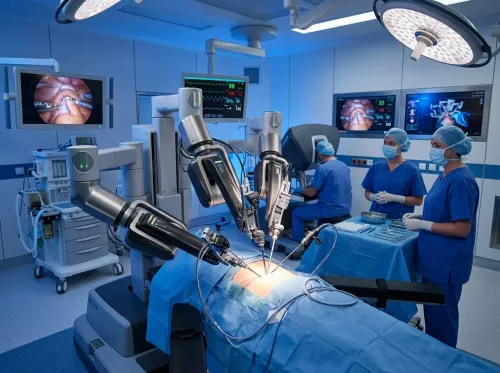
A laparoscopic ovarian cancer surgeon should explain whether the planned operation is cyst removal, removal of one ovary, inspection, staging or cytoreduction. If cancer is found unexpectedly, ask about avoiding rupture, immediate staging, frozen-section or pathology review, conversion to open surgery, and whether a second operation could be required.
What happens during an ovarian cancer consultation in Pune
Bring the complete ultrasound or MRI report and the actual images, not only a phone photograph of the conclusion. Add CA-125 and other tumour-marker results, blood counts, previous operation notes, biopsy reports, medication list, and records of earlier endometriosis treatment.
Ask these questions during an ovarian cancer laparoscopy consultation Pune patients attend:
- Does the scan require review by a radiologist experienced in gynaecologic cancer?
- Is the proposed procedure intended to diagnose, formally stage, or debulk disease?
- What tissue will be removed or sampled, and who will review the pathology?
- What happens if cancer is found during laparoscopy?
- Will the operation need conversion to an open procedure, and what is the surgeon’s conversion rate?
- Does the surgeon have specific training and experience in complete ovarian-cancer staging and cytoreduction?
Expect questions about pain, bloating, early fullness, urinary or bowel changes, weight loss, bleeding, menstrual history and symptom duration. The examination may assess the abdomen, pelvis, mass mobility and signs of ascites; CA-125 alone cannot confirm or exclude cancer.
Tell the surgeon about pregnancy plans, prior pelvic surgery, family history of ovarian, breast, bowel or uterine cancer, and known BRCA1 or BRCA2 results. Dr.Kunaal Shinde- Gynaec Laparoscopic Surgeon Pune can help clarify whether fertility-preserving surgery, genetic counselling, tumour testing or referral to a gynaecologic oncology team belongs in the plan.
Related services
Laparoscopy Surgery Diagnostic Hystero Laparoscopy Lap Surgery for Endometrisis Lap Surgery for Ectopic Pregnancy Lap Surgery for uterine Anomalies Lap Cerclage... View service → |
Gynaec Onco Surgery Cervical Cancer Ovarian Cancer Uterine Cancer Fallopian Tube Cancer Vulvar Cancer View service → |
Why the operation must match the cancer-staging plan
A cyst operation is not automatically a cancer operation. The planned procedure must reflect whether the goal is inspection, symptom relief, fertility preservation, staging, or removal of all visible disease.
| Operation | What it does | Main limitation or requirement |
|---|---|---|
| Diagnostic laparoscopy | Inspects the abdomen, collects washings and biopsies, and assesses whether disease appears removable | It does not automatically provide complete FIGO staging |
| Endometrioma surgery | Removes an endometriotic cyst, often while preserving ovarian tissue | It can rupture a malignant mass or leave cancer unstaged if the diagnosis is wrong |
| Fertility-preserving surgery | May preserve the uterus and unaffected ovary in carefully selected, limited cancers | It requires favorable pathology, formal staging and a recurrence-risk discussion |
| Formal ovarian cancer staging | Uses washings, biopsies, omentectomy and selected lymph-node assessment to determine spread | It may require open surgery or conversion from laparoscopy for safe, complete treatment |
A laparoscopic ovarian cancer surgeon should explain what happens if cancer appears during the operation. Unexpected rupture can spill tumour cells into the abdomen and change the recorded stage, while incomplete removal can leave residual disease, obscure the true extent and require a second staging operation. Minimally invasive access is secondary to safe, complete treatment.
Ask whether the proposed procedure is intended to stage, debulk, or only remove a cyst. A gynecologic cancer staging Pune consultation should also cover pathology review, the plan for tumour rupture, conversion to laparotomy, and access to chemotherapy planning.
Symptoms, fertility choices and treatment planning after assessment
Sudden severe pelvic pain, repeated vomiting, fainting, fever, heavy vaginal bleeding, or a rapidly swollen abdomen needs emergency assessment; these symptoms can indicate torsion, rupture, bleeding, infection, or bowel obstruction. Arrange prompt review for persistent bloating, early fullness, unexplained weight loss, new urinary pressure, or bleeding after menopause.
At an endometriosis expert pune laparoscopic surgeon ovarian cancer consultation, state whether preserving pregnancy is a priority now or later. Endometrioma surgery can reduce ovarian reserve, especially after bilateral or repeat operations, so discuss AMH and antral follicle count, egg or embryo freezing, observation, and whether symptoms or suspicious imaging justify surgery.
| Finding or goal | Effect on planning | Question to ask |
|---|---|---|
| Strong fertility goal | Consider ovarian-sparing surgery only when cancer risk and disease distribution allow it | What tissue must be removed, and what will happen to ovarian reserve? |
| Suspected epithelial ovarian, fallopian-tube, or peritoneal cancer | Offer BRCA1, BRCA2 and broader hereditary-risk testing; test tumour biomarkers when indicated | Could results change treatment or relatives’ screening? |
| Extensive disease or incomplete safe removal | Chemotherapy before surgery can be considered; other cases need surgery followed by chemotherapy | Is the plan staging, debulking, or chemotherapy first? |
A gynecologic cancer staging Pune plan should identify washings, biopsies, omentectomy, lymph-node assessment, and pathology review. Confirm what happens if cancer appears unexpectedly during laparoscopy; routine endometriosis excision is not an adequate cancer operation.
Frequently asked questions
How does an endometrioma differ from suspected ovarian cancer?
An endometrioma often has a uniform low-level ground-glass ultrasound pattern, smooth walls and no solid nodules or internal blood flow. Painful periods, deep pelvic pain, infertility or known endometriosis support the diagnosis, but none of these findings excludes cancer.
When should an ovarian mass be observed, rescanned, operated on or referred?
Observation or repeat imaging may fit a characteristic, stable endometrioma without concerning symptoms. Solid nodules, internal blood flow, growth, complex features or unexplained symptoms require specialist review and may require surgery or referral to a gynecologic cancer team.
What happens during an ovarian cancer consultation in Pune?
The consultation reviews symptoms, menstrual and fertility history, prior scans, examination findings and risk factors. The specialist explains whether you need repeat imaging, tumour-marker testing, laparoscopy, open surgery or referral for gynecologic oncology planning.
Why must ovarian surgery match the cancer-staging plan?
If cancer is found, the operation may need to collect peritoneal washings, inspect the abdomen, remove or sample the ovaries and other tissues, and obtain lymph-node or omental specimens. Planning the procedure around staging helps avoid incomplete treatment or an avoidable second operation.
How do symptoms and fertility goals affect treatment planning?
Pain, bleeding, pressure symptoms and fertility plans influence whether observation, medical treatment, cystectomy or removal of an ovary is considered. Discuss pregnancy goals before surgery so the plan reflects both safety and reproductive priorities.
Related service
Gynaec Laparoscopic Surgery Gynecologic laparoscopic surgery is a minimally invasive procedure that allows a surgeon to diagnose and treat gynecological conditions. View service → |