
Endometriosis can affect the ovaries, tubes, bowel, bladder and pelvic ligaments, yet a normal ultrasound does not rule it out. You will learn which findings call for specialist assessment, how disease is mapped before surgery, what robotic laparoscopy changes, and how to compare treatment choices in Pune.
Key takeaways
- Severe period pain, deep intercourse pain and infertility warrant endometriosis assessment.
- MRI and expert ultrasound help map ovarian, bowel, bladder and deep pelvic disease.
- Robotic laparoscopy improves instrument control but cannot guarantee pain relief or pregnancy.
- Ask about surgeon experience, disease mapping, fertility goals and coordinated follow-up.
When pelvic pain and fertility problems point to endometriosis
Severe period pain that disrupts work, deep pain during intercourse, chronic pelvic pain, painful bowel movements, urinary pain during menstruation or infertility justify referral to an endometriosis specialist. Examination findings such as tenderness behind the uterus, pain over the uterosacral ligaments, an ovarian endometrioma, reduced organ mobility or a fixed pelvic mass strengthen the case.
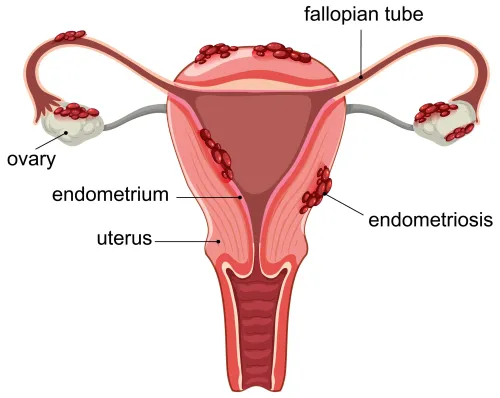
Endometriosis can form superficial lesions on the pelvic peritoneum, deep nodules in the uterosacral ligaments, endometriomas in the ovaries, adhesions around the fallopian tubes and disease involving the bowel or bladder. Bowel lesions can cause cyclical pain with defecation; bladder lesions can cause cyclical urinary pain or blood in urine.
Tubal adhesions can impair egg pickup and fertility.
- Refer for specialist assessment when these symptoms recur with menstruation, persist between periods, or combine with abnormal examination findings.
- Do not dismiss symptoms after a normal ultrasound. Superficial lesions and some deep disease are difficult to visualise, so a normal scan does not exclude endometriosis.
| Condition | Clues that may differ |
|---|---|
| Endometriosis | Cyclical pain, endometriomas, adhesions or deep nodules |
| Adenomyosis | Enlarged tender uterus and heavy, painful periods |
| Pelvic-floor dysfunction | Muscle spasm and pain reproduced by pelvic-floor examination |
| Irritable bowel or bladder syndromes | Bowel or urinary symptoms without visible pelvic lesions |
Adhesions from previous surgery and non-gynaecological pain can coexist. Searching “endometriosis expert Pune robotic laparoscopic for gynec surgeon care” should lead you to specialist evaluation, not a promise that surgery will cure every pain mechanism.
How specialists investigate and map the disease before surgery
The decision about laparoscopy starts with evidence, not a scan alone. A gynecologic laparoscopy specialist in Pune will usually build the picture in stages:
1. Take a detailed history: pain severity and location, pain during intercourse, painful bowel movements, urinary pain during menstruation, bleeding pattern, cycle timing, infertility, prior pregnancies, fertility goals, previous pelvic or abdominal operations, and earlier treatment. Note whether pain is cyclic, worsening, or present between periods.
2. Perform a pelvic examination. Tender uterosacral ligaments, reduced uterine mobility, nodules, an ovarian mass, or a fixed pelvic mass can suggest adhesions or deep disease, but a normal examination does not exclude endometriosis.
3. Arrange an expert transvaginal ultrasound. It can identify ovarian endometriomas, adhesions, reduced organ mobility, and some lesions involving the bowel, bladder or uterosacral ligaments. Superficial peritoneal disease remains easy to miss.
4. Request pelvic MRI when deep infiltrating endometriosis is suspected. MRI can show the depth and location of disease near the bowel, bladder, ureters, vagina or pelvic nerves, helping arrange colorectal, urological or other specialist support.
Doctors distinguish superficial peritoneal lesions, ovarian endometriomas and deep infiltrating disease because each changes the operation. Imaging guides surgical planning; it cannot promise a complete map of every lesion. A normal ultrasound or MRI does not rule out superficial disease, and diagnostic laparoscopy is not mandatory for every suspected case.
Hormonal treatment, monitoring or fertility-focused care may be appropriate before surgery.
What robotic laparoscopic surgery does for ovarian and deep disease
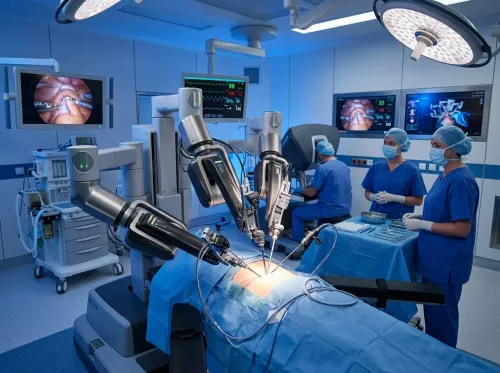
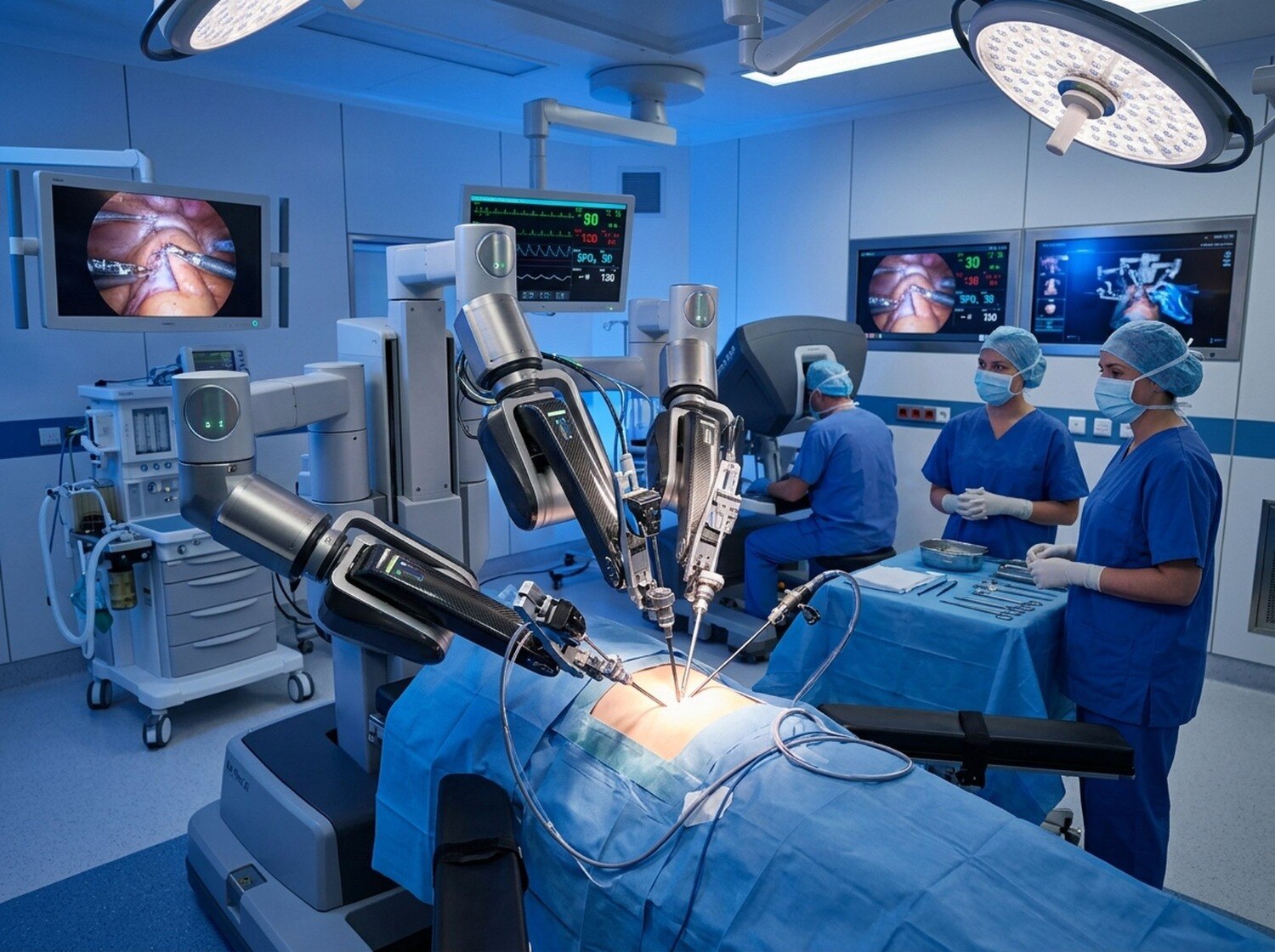
Robotic laparoscopic surgery for endometriosis uses small abdominal ports for a camera and instruments. The surgeon views the pelvis in magnified three-dimensional detail and controls wristed instruments from a console; the robot does not diagnose or dissect independently. Adhesiolysis frees organs stuck together by scar tissue before lesions are removed or treated.
Technique depends on lesion depth, location and organ involvement, not simply on choosing robotic or conventional laparoscopy.
| Technique | What it does | When it fits |
|---|---|---|
| Excision | Removes visible disease through its depth | Preferred for deep lesions or disease near structures where surface treatment would leave tissue behind |
| Ablation | Destroys the visible surface with energy | Limited to suitable superficial disease; unsuitable when infiltration extends deeper or lies near vulnerable bowel, ureter, bladder or nerves |
| Cystectomy | Removes the wall of an ovarian endometrioma | Often controls pain and recurrence better than drainage with coagulation, but can remove healthy ovarian tissue |
For an endometrioma, consent should cover AMH, antral follicle count, age, previous ovarian surgery and fertility plans. Cystectomy can reduce ovarian reserve, so fertility preservation or assisted reproduction may deserve discussion before operating.
Deep bowel disease may require shaving, discoid excision or segmental resection. Ureteric disease may require ureterolysis, temporary stenting or reconstruction, with colorectal or urological support when indicated. The plan should also address possible injury to bowel, bladder, ureter, vessels or nerves, conversion to open surgery, and residual or recurrent disease.
What the robot changes, and what it cannot guarantee
Robotic assistance improves three-dimensional visualisation, wristed instrument movement and surgeon ergonomics, especially during difficult pelvic dissection. The surgeon still identifies, dissects and removes disease; the robot does not diagnose or operate independently.
| Option | What it offers | When it fits and what to weigh |
|---|---|---|
| Robotic laparoscopy | Enhanced view, articulation and control | Complex dissection; higher equipment cost and possible extra operating time |
| Conventional laparoscopy | Established minimally invasive access | Suitable when disease and surgeon expertise permit; no proven universal disadvantage for pain or fertility |
| Hormonal treatment | Controls symptoms and suppresses disease activity | When pregnancy is not an immediate goal; it does not remove existing lesions |
| Assisted reproduction | Bypasses some tubal or fertility barriers | Consider age, ovarian reserve, tubal status, semen analysis, disease history and prior operations before repeating surgery |
| Open surgery | Wider access for extensive disease or safer completion | Used when disease extent, bleeding or organ safety requires conversion |
Robotic surgery has not been established as universally superior for pain relief, fertility, recurrence or long-term quality of life. Compare the platform, surgeon experience and team support rather than choosing the word “robotic” alone.
Consent must cover bowel, bladder, ureter, vessel or nerve injury, transfusion, fistula, infection, adhesions, conversion to open surgery and residual or recurrent disease. Endometriosis can recur, so surgery is not a guaranteed cure or universal fertility treatment; postoperative hormonal therapy or assisted reproduction may better match your goals.
How to choose an endometriosis surgeon and coordinated Pune team
Ask for the surgeon’s number of comparable advanced endometriosis operations in the past 12 months, not a generic claim of expertise. For endometriosis expert Pune robotic laparoscopic for gynec surgeon care, judge the whole team and hospital, not the word “robotic” alone.
- What is the planned procedure: excision, ablation, endometrioma cystectomy, adhesiolysis, or another operation? Ask what happens if deeper disease appears.
- Who will manage bowel, bladder, ureteric, vaginal or pelvic-nerve disease?
- Are colorectal and urological surgeons available during planned surgery, and can they perform shaving, discoid resection, ureterolysis, stenting or reconstruction?
- What is the centre’s process for bleeding, organ injury, transfusion, infection, fistula and conversion to open surgery?
- How will ovarian reserve be assessed using AMH and antral follicle count, and when will fertility preservation be discussed?
- What postoperative hormonal plan applies if pregnancy is not immediate?
- If you want pregnancy, when will fertility treatment or assisted reproduction be considered?
| Option | Main question | Important trade-off |
|---|---|---|
| Robotic laparoscopy | Is wristed three-dimensional dissection useful for this disease distribution? | Higher equipment cost and possible extra operating time |
| Conventional laparoscopy | Can the surgeon and team safely complete the mapped procedure? | Less instrument articulation |
| Open surgery | Would access improve safety for extensive disease? | Larger incision and longer recovery |
Dr.Kunaal Shinde- Gynaec Laparoscopic Surgeon Pune is one practice option for specialist evaluation and minimally invasive planning in Hinjewadi; compare its proposed plan, team access and fertility counselling with alternatives. No platform guarantees pain relief, fertility or absence of recurrence.
Related services
Laparoscopy Surgery Diagnostic Hystero Laparoscopy Lap Surgery for Endometrisis Lap Surgery for Ectopic Pregnancy Lap Surgery for uterine Anomalies Lap Cerclage... View service → |
Gynaec Laparoscopic Surgery Gynecologic laparoscopic surgery is a minimally invasive procedure that allows a surgeon to diagnose and treat gynecological conditions. View service → |
Frequently asked questions
When should pelvic pain or fertility problems prompt an endometriosis referral?
Seek specialist assessment for severe period pain that disrupts work, deep pain during intercourse, chronic pelvic pain, painful bowel movements, urinary pain during menstruation or infertility. Tenderness behind the uterus, uterosacral ligament pain, an endometrioma, reduced organ mobility or a fixed pelvic mass strengthen the case.
How is endometriosis investigated before surgery?
A specialist combines your symptom history and pelvic examination with imaging. Expert transvaginal ultrasound can assess endometriomas and deep disease; MRI helps define extensive disease involving the bowel, bladder or ureters. The team uses these findings to plan surgery and discuss fertility goals.
What does robotic laparoscopic surgery do for endometriosis?
Through small abdominal incisions, the surgeon uses a camera and instruments to remove endometriosis, treat ovarian endometriomas and release adhesions. Robotic systems provide magnified three-dimensional vision and wristed instrument movement, which can help with precise dissection in deep or anatomically difficult areas.
What can robotic surgery not guarantee?
Robotic assistance cannot guarantee complete disease removal, permanent pain relief, improved fertility or avoidance of recurrence. Outcomes depend on disease location, ovarian reserve, bowel or urinary tract involvement, surgical planning and follow-up treatment.
How do you choose an endometriosis surgeon and Pune care team?
Ask how often the surgeon treats ovarian and deep endometriosis, how imaging is mapped before surgery, how fertility goals affect the plan and whether colorectal or urology support is available when needed. Discuss risks, possible conversion to another approach, recovery and follow-up before consenting.